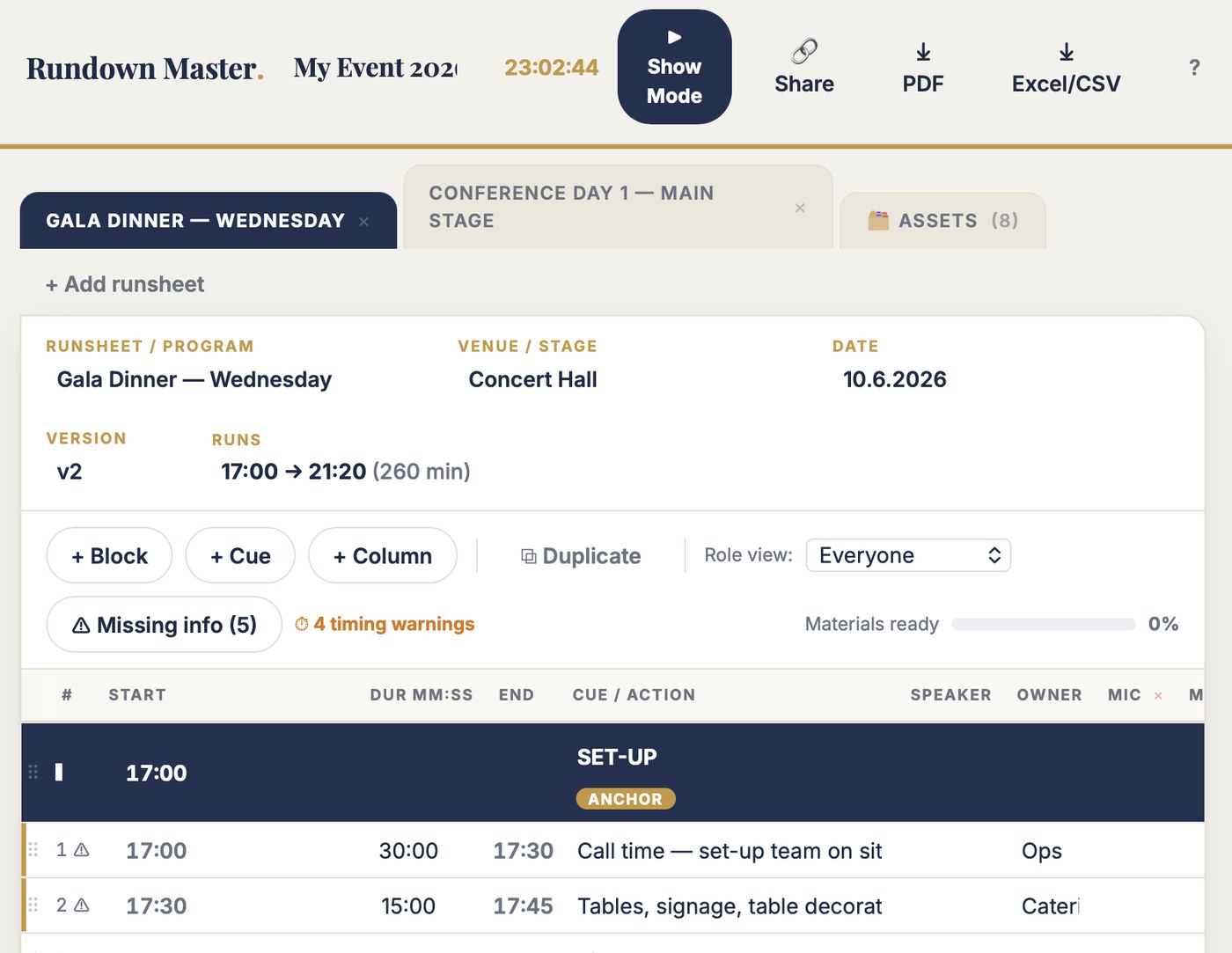
Rundown Master is where you plan and time the run of show: the keynotes, the ceremony, the gala, block by block, cue by cue. Anchor a start, give each cue a duration, and the whole script times itself. Move a keynote, cut a segment, add a break — the timing re-flows in a blink, so you get the important sessions right while there is still time to change them.
Share one link with the technical team and partners. When show day arrives, everyone is working from the same agreed script — not five versions of an Excel. That is the whole product. (A show mode to run it live is included.)
Anchor a block, give each cue a duration, and every start and end time builds itself. There is no formula to break while you edit, so you can shape the timing of the important sessions freely — for weeks — and the clock always adds up.
Move a keynote 40 minutes, cut a segment, add a coffee break — drag one row and the entire script re-times. Getting the run of show right stops meaning re-typing forty rows every time the programme changes.
No five versions on the drive. Share a view-only link with the technical team, partners and hosts; everyone sees the current plan. When show day comes, there is one agreed script — and a show mode included to run it.
The free test is the full tool on a real example event. Add a cue, set a duration and watch the script re-time. Move a keynote and watch the whole evening re-flow. Filter to one role and print it. Then press ▶ Show Mode to see how the same script runs on the day.
No account. No email. Nothing saves. Two minutes tells you more than this page can.
| The job | Your spreadsheet | Rundown Master |
|---|---|---|
| Timing the script | Someone types over the formula in C14 while editing. Every start time below it is now wrong — found at rehearsal, if at all. | Times chain from durations. There is no formula to break, so you can shape the timing freely. |
| The programme moves | A keynote shifts 40 minutes, and you re-time forty rows by hand — again, and again, all through planning. | Drag the row. The whole remaining script re-times in a blink. |
| Detail for each role | Seven crew roles, so the sheet grows to 74 columns. Nobody can find their own cues. | Add the columns your production needs. Filter to one role and print just that. |
| The version everyone works from | Rundown_FINAL_final_USE_THIS.xlsx — five files, one event, zero certainty which is current. | One script, one link, always current. No copies to reconcile. |
| Handing it to the crew | A printout emailed round, stale by the next edit. | A view-only link for the technical team — or a live show-mode link for the day. |
| The assets | The keynote PPT lives in three folders. Nobody knows which is final. | One asset library — every PPT, video and song marked ready or missing, attached to its cue. |
These are from running orders I planned and re-planned for world championships, medal ceremonies and corporate conferences. The logic — anchors, cues, durations, owners — was right the whole time. The spreadsheet punished every edit, so getting the important moments timed right cost days it shouldn't have. Rundown Master keeps the logic and makes the plan easy to change.
A folder you may recognise
Five files. One event. Zero certainty which one the technical team is planning from.
Rundown Master is for the producer or director who builds and times the script for the moments that matter — the ceremony, the gala, the keynote block — and who needs the whole crew working from one agreed version long before anyone is on stage.
A planning tool for live sessions. Blocks carry anchor times. Cues chain automatically: each one starts when the previous ends. Change a duration, drag a row, cut a segment — the clock recalculates every time, and it cannot break. This is where you get the run of show right: the timing, the cues, who owns what, what's on each screen.
Share one link and the technical team, AV partner and hosts all plan from the same script. When the day comes, a full-screen show mode is included to run it — but the work that makes the evening hold is done here, in planning.
| Start | Dur | End | Cue / Action | Speaker | Mic | Screen | |
|---|---|---|---|---|---|---|---|
| 18:30 | DINNER PROGRAMANCHOR | ||||||
| 1 | 18:30 | 2 | 18:32 | Welcome — introduce the Mayor | Host | Hand ×1 | Event logo |
| 2 | 18:32 | 5 | 18:37 | Mayor's welcome speech | Mayor | Hand ×1 | Name slide |
| 3 | 18:37 | 0:30 | 18:37 | Transition — podium out | Fade to dark | ||
| 4 | 18:37 | 3 | 18:40 | Orchestra: opening piece | Orchestra | Title slide | |
| 5 | 18:40 | 10 | 18:50 | Orchestra: main set | Orchestra | ||
When the planning is done, ▶ Show Mode runs the same script on the night: full screen, live clock, the current cue highlighted with a countdown, the next cues below. A speaker runs over? Tap +1 minute and the remaining schedule shifts.
It's a bonus, not the point — if you need an advanced live caller, dedicated tools do more. What matters here is that the script you ran the room with is the exact one you planned and agreed, with no re-typing in between.
Rundown tools priced as subscriptions cost €300–1,200 per year. One run of show timed right — and one agreed script instead of five Excel versions — is worth that before the doors even open. Test first — buy when it earns its place.
Pairs with Daily Runsheet: Rundown Master times the show, Daily Runsheet times the whole event day around it. Nine tools in the toolbox — any three for €199.
You can. I did, for 25 years — and the timing broke every time I edited it, and the versions multiplied. The logic was right; the fragile clock and the copies were the problem. If your running order survives weeks of edits without breaking, keep it. This is for everyone else.
No — its core is planning. You use it to time the run of show, get the important sessions right, and share one agreed script with the crew. A show mode is included to run it on the day, but if you need advanced live calling — comms, device cues, redundancy — dedicated show-caller software does more. Most organisers need the plan right first; that's what this does.
No. Rundown Master runs in the browser — laptop, tablet or phone. Your events save automatically to your account.
No. You send them a view-only link. They plan from the current script, or open the live show mode, and cannot break anything.
Yes. Every runsheet exports to CSV (opens in Excel) and prints to A3 landscape. The spreadsheet becomes an output, not the tool you fight while planning.
The full tool on an example event. Build cues, set durations, drag rows and watch the script re-time; filter by role; then run show mode. Nothing saves — 100 people can test at once and never see each other's changes.
Two minutes in the demo tells you more than this page can.